Performance Paradigm: The Leadership Model That Balances Results and Relationships
The Performance Paradigm: The Leadership Model That Balances Results and Relationships
Most Leaders are measured on performance — but performance is never just about tasks.
It’s about how people work, not only what they deliver.
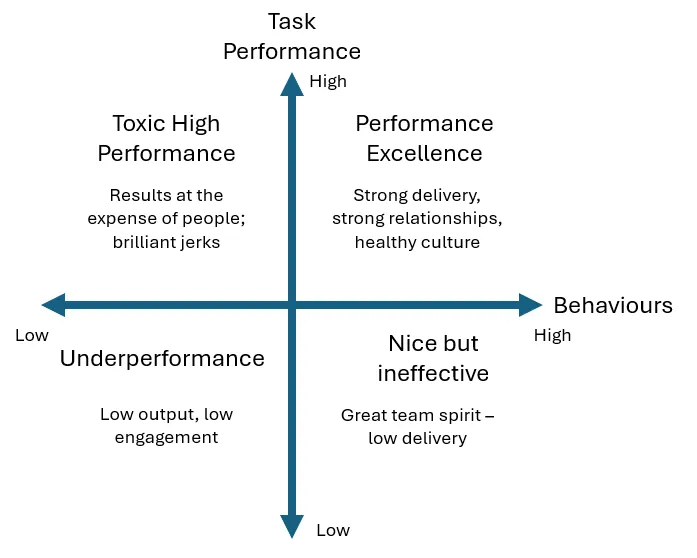
The Performance Paradigm helps Leaders understand this balance. It maps performance across two axes:
Task Performance — delivery, output, quality, productivity
Behaviours — collaboration, communication, mindset, values, emotional intelligence
Together, these create four performance climates that shape how individuals and teams show up.
At its core, the model reminds us:
High performance is only sustainable when high task delivery is matched with high behavioural standards.
🧭 What Is the Performance Paradigm?
The model creates four quadrants based on the combination of task performance and behaviours:
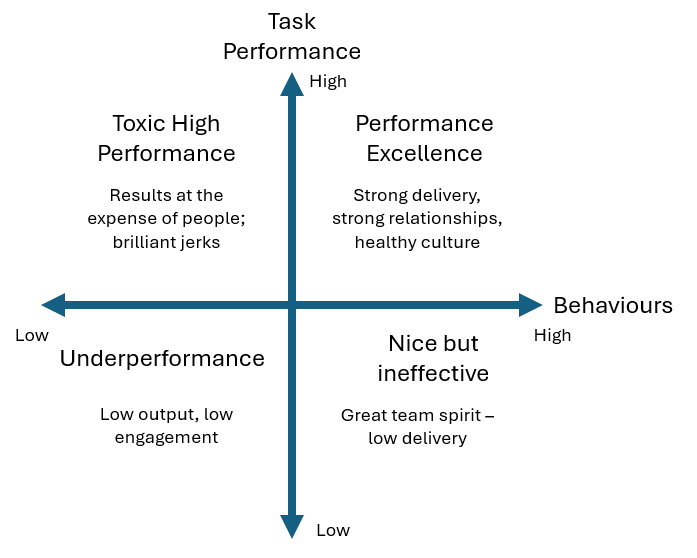
The goal is clear: move individuals and teams toward Performance Excellence, where both delivery and behaviour are aligned.
💡 Why This Model Matters for Leaders
1. It stops leaders rewarding the wrong things
Many organisations unintentionally reward:
the high performer who leaves a trail of damage
the “nice” team member who never quite delivers
The model exposes these imbalances.
2. It creates a shared language for performance
Instead of vague feedback like “you need to step up,” leaders can say:
“Your delivery is strong, but your behaviours are impacting the team.”
“Your behaviours are excellent — now let’s raise your delivery.”
It makes performance conversations clearer and fairer.
3. It protects culture
High task performance without behavioural alignment is the fastest route to:
conflict
mistrust
psychological harm
team fragmentation
The model helps leaders intervene early.
4. It supports sustainable performance
Excellence isn’t just about hitting targets — it’s about doing it in a way that strengthens the team, not drains it.
🔄 How Leaders Can Apply the Performance Paradigm
1. Diagnose where each team member sits
Ask:
Are they delivering?
Are they living the behaviours we expect?
This gives you a clear starting point.
2. Tailor your leadership response
Each quadrant requires something different:
Excellence → Stretch and empower
Toxic High Performance → Hold behavioural boundaries firmly
Nice but Ineffective → Increase clarity, expectations, and accountability
Underperformance → Reset expectations, coach, or exit
3. Make behaviours explicit
Define what “good behaviours” look like in your team:
collaboration
ownership
communication
adaptability
emotional intelligence
People can only meet expectations they understand.
4. Celebrate behavioural wins, not just task wins
When leaders praise only output, they accidentally create Toxic High Performance.
When they praise behaviours too, they reinforce culture.
5. Use the model in performance reviews
It creates a balanced, fair, and transparent framework for:
feedback
development plans
promotions
reward decisions
✨ A Final Thought
Task performance shows what someone does.
Behaviour shows how they do it.